
Electric heat tracing systems for the chemical industry
The chemical industry places the highest demands on heat tracing systems - substances with specific properties, a high risk of crystallisation and strict safety requirements in hazardous areas. Our systems are designed and installed in full compliance with the ATEX directive.
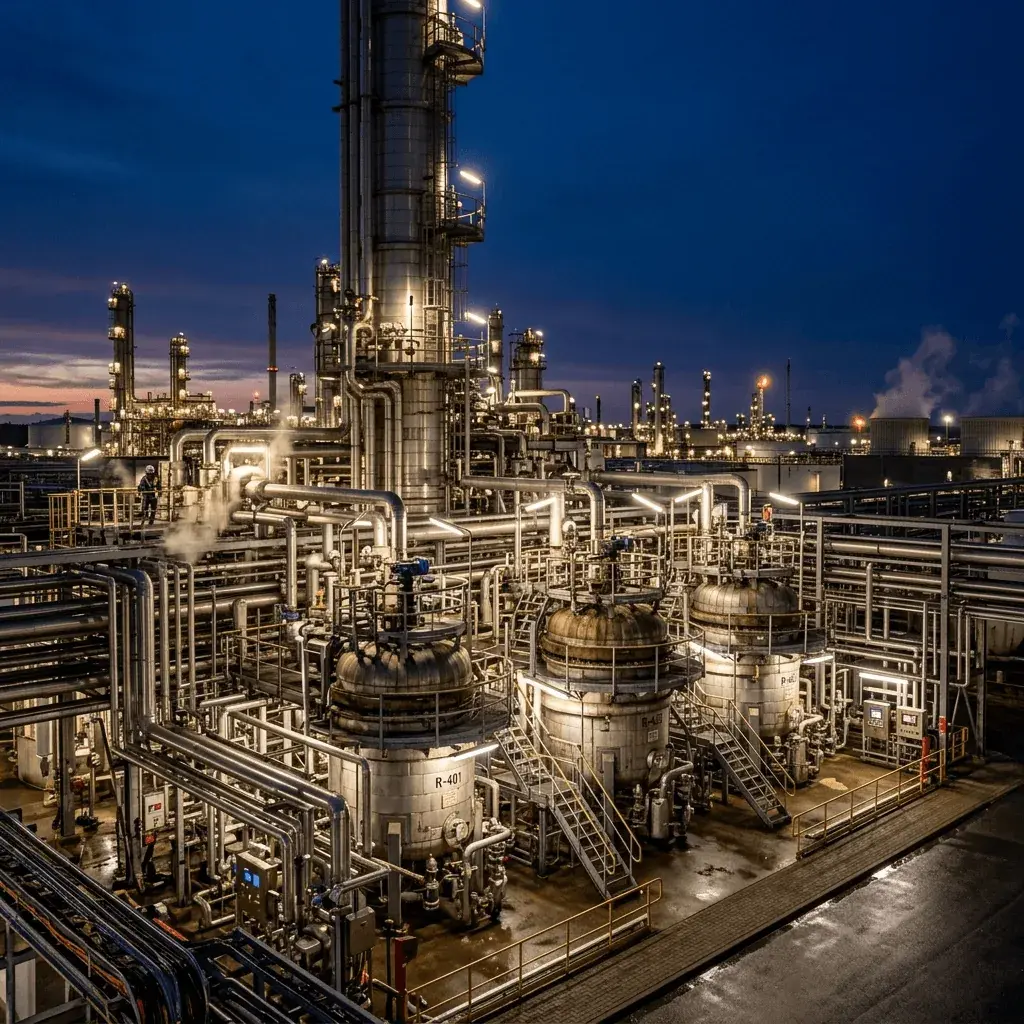
Preventing crystallisation and solidification
In chemical plants, the consequences of an incorrect medium temperature can be serious - from a blocked line to a risk of explosion. We heat trace:
- Lines carrying crystallising substances: Acids, alkalis, salts and other chemical compounds that need a constant temperature to stay liquid.
- Reactor and storage tanks: Protection against sediment formation and loss of homogeneity.
- Chemical dosing systems: Lines and pumps in dosing systems, which are particularly prone to thickening when flow is low.
- Filters and separators: Protecting filter elements against clogging by crystallised substances.
Solutions for hazardous areas (Ex)
A large share of the installations in chemical plants operates in hazardous areas. Our systems meet ATEX requirements:
- ATEX-certified heating cables: Cables with sheaths that prevent sparking, approved for use in Zones 1, 2, 21 and 22.
- Sealed connection boxes: Explosion-protected components matching the area classification.
- Temperature limiters: Protection that prevents the ignition temperature of the substance from being exceeded.
- ATEX documentation: Complete Ex selection documentation for the entire system, required for acceptance of the installation.
A comprehensive approach to every project
- Analysis of media properties: We examine the crystallisation points, viscosity and temperature requirements of each substance.
- Heat loss calculations: Precise heat loss analysis taking into account thermal insulation, ambient temperature and pipe wall thickness.
- Control selection: Safe systems with thermostats and thermometers resistant to aggressive environments.
"Every installation in a chemical plant is an individual project for us. We do not use standard solutions where the substance or the hazardous area calls for a specific approach."
Heating cables for the chemical industry
In a chemical plant, cable selection starts with the media and the area classification, and only then with output. The key criteria:
- Chemical resistance of the outer jacket - cables with a fluoropolymer outer jacket wherever contact with chemicals and their vapours is possible.
- Hazardous area certification - cables, connection kits and thermostats with ATEX/IECEx certificates, selected for the zone and temperature class (T-rating).
- Maintain and exposure temperature - self-regulating cables for lower temperatures, power-limiting or series MI cables for high process temperatures and steam purging.
- Precise control - media that crystallise or decompose at excessive temperatures require control with a pipe-mounted sensor and alarms.
We select cables, accessories and control as one system, then design, supply, install and commission the installation.
Frequently asked questions
Do you handle design and installation, or supply only?
+
We deliver heat tracing for chemical plants as a complete service: selection, design, supply, and installation and commissioning. Supply only, with technical selection, is also possible.
How do you prevent crystallisation and solidification of substances?
+
We keep media above their crystallisation or solidification point in pipelines, tanks and valves. Selection (cable type, output, control) is based on the parameters of the specific substance and installation.
Do you carry out installations in certified hazardous areas (Ex)?
+
Yes. In hazardous areas we use certified cables and accessories (ATEX/IECEx) and temperature limiters, and installation is carried out in line with the area classification - standard practice in the chemical industry.
Do you select solutions resistant to aggressive media?
+
Yes. For chemically aggressive environments we select cables with suitable jackets and accessories resistant to the specific medium and operating conditions.
How much does heat tracing cost in a chemical plant?
+
The cost depends on the type and length of the installation, the media, the hazardous area requirements and the scope (supply only, or design and installation). Once you provide the basic data, we will prepare a selection and a tailored quotation.
We will find the right solution
for chemical plants
We usually prepare quotations within 24 hours. Talk to our specialists - we will advise free of charge and select a heat tracing system that fits the specific needs of your industry. Enquiries in English are welcome.
- Free technical consultation
- Power output and complete accessory selection
- Backed by 30+ years of experience