
Guides
How much does gutter and driveway heating cost for a commercial building?
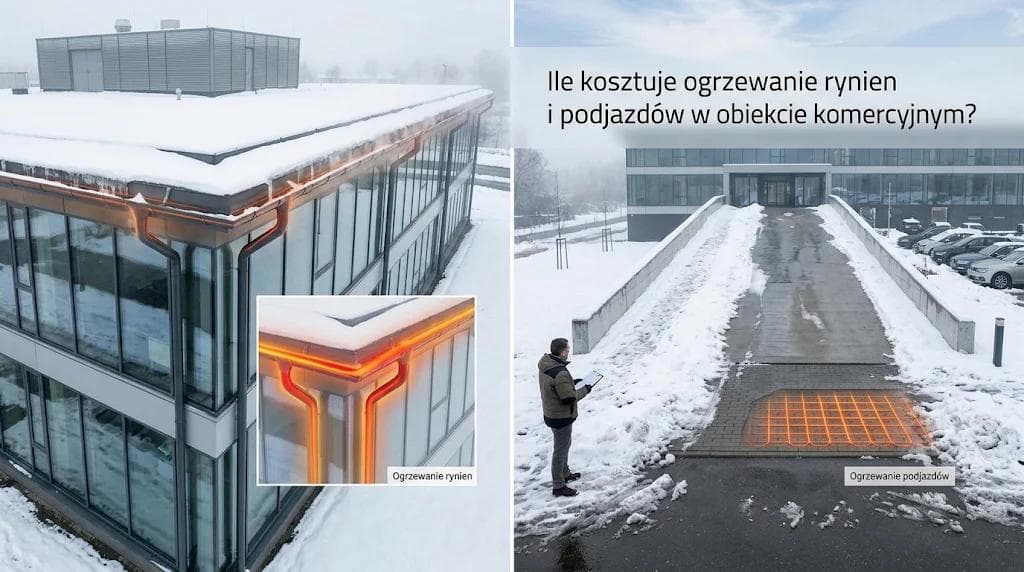
This guide covers commercial and industrial sites: production halls, logistics centres, public buildings and properties run by owners' associations or facility managers. The cost of gutter or driveway heating depends mainly on length or area, the required output (W/m or W/m²), the control method and installation conditions.
The total cost is made up of materials (cable, controls, accessories), design, installation and commissioning, followed by energy use. With automatic control using a snow and moisture sensor, consumption is many times lower than with continuous operation, because the system only heats when there is a real risk of ice.
Below we break the cost down into its components, so you can compare quotations more easily and plan the project budget.
What makes up the cost of a gutter and driveway heating installation?
The price of an installation is not just metres of cable. On commercial sites, a large share of the budget goes on controls, power supply and installation work in hard-to-reach places.
- Heating materials - What it covers: heating cables, power connection kits, fixings, junction boxes; What it depends on: length of gutters and downpipes, driveway area, required output
- Controls - What it covers: thermostat, controller, temperature, snow and moisture sensors; What it depends on: number of zones, required level of automation, BMS integration
- Design - What it covers: output selection, division into circuits, power supply diagram; What it depends on: size and complexity of the building
- Installation - What it covers: laying and fixing the cables, work on the roof or in the surface; What it depends on: building height, need for a lift platform, type of surface
- Commissioning - What it covers: measurements, tests, control settings, as-built documentation; What it depends on: number of circuits
- Power supply - What it covers: distribution panel, protective devices, supply cabling; What it depends on: total load, distance from the existing switchboard
That is why two “per metre” quotations can differ widely: one covers the cable alone, the other a complete installation with controls, control panel and handover.
How much does gutter and downpipe heating cost on an industrial building?
The cost of gutter and downpipe heating on a commercial building depends above all on:
- metres of gutters and downpipes - on large halls this often means hundreds of metres, and downpipes must be heated along their full length down to the outlet below the frost line,
- roof valleys and drainage points - areas where snow collects need additional cable,
- gutter width - a narrow gutter usually needs one run of cable, a wide or box gutter two or more,
- output per metre - selected for the climate, roof exposure and type of drainage,
- roof access - hall height, the need to hire a lift platform, work at height,
- controls - a simple thermostat or a controller with snow and moisture sensors.
Gutters most often use self-regulating heating cables. They reduce their own output where it is warm or dry and increase it in cold, wet snow and ice. This limits energy use and the risk of overheating.
[OWITERM PRICE RANGE - optional, e.g. indicative cost per metre of gutter including installation, or the sentence: “We quote an exact price after reviewing the roof plan or a site visit.”]
How much does heating a driveway, ramp or external stairs cost?
Driveway and ramp heating is priced by area, but the price per m² depends on several factors:
- heated area - you often do not need to heat the whole yard; wheel tracks, a ramp or the weighbridge area may be enough,
- surface type - asphalt, block paving and concrete each require a different cable laying method,
- new or existing surface - on a new build the cable is laid before the surface is poured or laid; on an existing surface, milling and reinstatement are needed,
- output per m² - depends on the climate, gradient and required effect (full snow clearance or ice protection only),
- snow and ice sensor - recommended for any larger area, as it determines running costs,
- power supply - larger areas mean a high installed load and often a separate distribution panel.
External stairs at the entrances to public buildings are usually heated with cable run along the step edges, where most slips occur.
[OWITERM PRICE RANGE - optional, e.g. indicative cost per m² of driveway or ramp including installation.]
How much electricity does gutter and driveway heating use?
You can calculate running costs with a simple formula:
season cost = installed load (kW) × operating hours per season (h) × energy price (PLN/kWh)
Example calculation layout:
- installed load: [INSTALLED LOAD in kW],
- operating hours per season: [NUMBER OF HOURS],
- business energy price: [PRICE PER kWh].
The most important variable is the number of operating hours, and that is determined by the controls:
- an air-sensing thermostat switches the system on when the temperature falls below the set point, e.g. anywhere from just above zero to a few degrees below. So it also heats on dry, frosty days when nothing is freezing.
- a controller with a snow and moisture sensor switches the system on only when it is both cold and wet. Operating time over the season is then many times shorter.
With a high installed load, the difference in the energy bill between these two control methods quickly outweighs the difference in the price of the controller itself.
How can you reduce the cost of gutter and driveway heating?
The biggest savings come from designing the system well at the selection stage:
- Automatic control - a snow and moisture sensor instead of continuous operation or a thermostat alone.
- The right output - without oversizing. Too much output means higher costs for materials, power supply and energy.
- Self-regulating cable in gutters - it lowers its own output in dry and warmer sections.
- Zoning - a north-facing gutter behaves differently from a sunny ramp.
- Pre-season inspection - checking cable insulation, sensors and settings prevents failures in the middle of winter.
For control, we select thermostats and controllers matched to the scale of the site, from a single circuit to multiple zones.
What does going without heating cost?
On a commercial site, it is worth comparing the cost of the installation with the cost of not having one:
- icicles and ice overhangs - a hazard to pedestrians and vehicles, with liability for the consequences resting with the owner or facility manager,
- damaged gutters and downpipes - ice splits and tears off drainage components, and water floods the façade and interior,
- accidents on icy entrances and stairs - especially in public buildings,
- downtime at loading ramps and weighbridges - an icy ramp or weighbridge means halted deliveries and manual snow clearing.
These costs are hard to predict, whereas a heating installation turns them into a fixed, calculable running cost.
How do we prepare a quotation?
OWITERM has specialised in industrial electric heating for more than 30 years and has completed over 1,300 projects. We work with Raychem (Chemelex) products and deliver installations end to end: selection, detailed design, supply, installation, commissioning, as-built documentation, and inspections and service.
To prepare a quotation, we need:
- a roof plan showing the gutters, valleys and downpipes, or a site plan showing the area of the driveway, ramp or stairs,
- photos of the spots that cause problems in winter,
- power supply details - where the switchboard is and how much power is available,
- the building height and access conditions (for gutters),
- the surface type and whether it is a new build (for driveways).
On this basis we select the system, calculate the load and energy consumption, and prepare a quotation for the complete installation, not just the materials.
Send us your roof or driveway plan - we will prepare a quotation
Describe the installation and send us the roof or driveway plan, and we will select the system and prepare a quotation. Contact us: tel. +48 32 322 56 65, biuro@owiterm.pl.